Funding Rate Guide: What It Tells You About Market Sentiment
Crypto funding rate explained — and why it became one of the first things I check before entering any significant position.
Funding rate is one of those indicators that looks confusing at first but becomes essential once you understand it.
I ignored it for a long time because the mechanics seemed technical. But once I understood what it actually measures — whether the derivatives market is leaning too hard in one direction — it became one of the first things I check before entering any significant position.
In this guide, I’ll break down how perpetual futures work, what funding rate is, how to read it, and how I use it as a contrarian signal.
How Perpetual Futures Work
To understand funding rate, you first need to understand perpetual futures.
A traditional futures contract has an expiry date — you agree to buy or sell an asset at a set price on a specific date. Perpetual futures have no expiry. You can hold a long or short position indefinitely, as long as you maintain sufficient margin.
The problem with no expiry is that the perpetual contract price can drift away from the spot price. If everyone is bullish and piling into longs, the perpetual price gets pushed above spot. Exchanges solve this with a mechanism called the funding rate.
What is Funding Rate?
Funding rate is a periodic payment exchanged between long and short position holders, designed to keep the perpetual contract price anchored to the spot price.
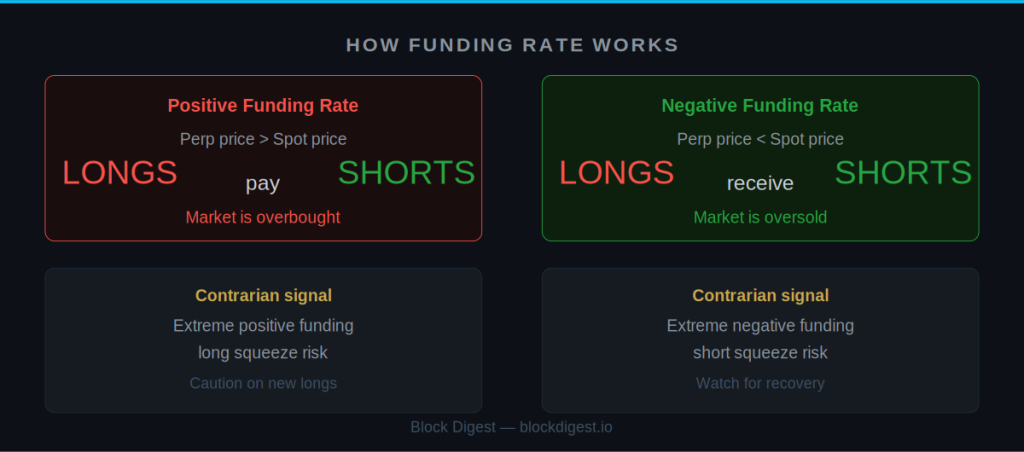
- Positive funding rate — longs pay shorts. This happens when the perpetual price is trading above spot, meaning more demand for longs than shorts.
- Negative funding rate — shorts pay longs. This happens when the perpetual price is trading below spot, meaning more demand for shorts than longs.
Most exchanges settle funding every 8 hours. The rate is usually small — often 0.01% per 8 hours in neutral conditions — but it adds up quickly during extreme market conditions when rates spike.
Reading Funding Rate as a Market Signal
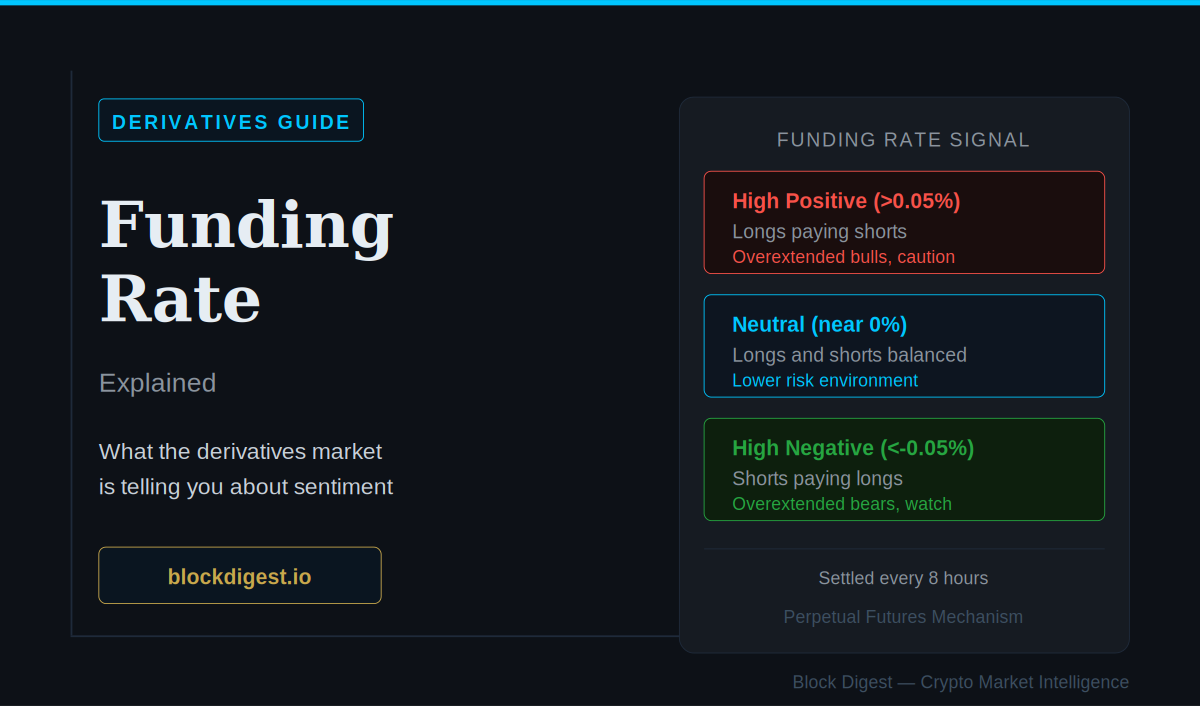
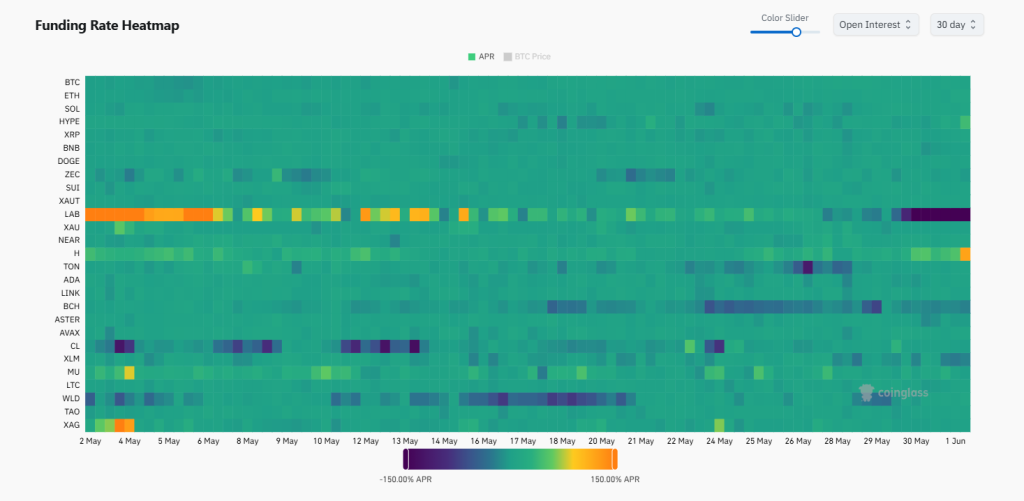
The funding rate isn’t just a fee — it’s a real-time gauge of market sentiment and positioning. Here’s how to read it:
High positive funding
When funding rate is significantly positive (e.g. 0.05–0.1%+ per 8 hours), it means the market is heavily long. Traders are paying a premium to hold long positions, which signals extreme bullish sentiment. Historically, sustained high positive funding has preceded sharp corrections — the market gets overextended and even a small catalyst triggers a long squeeze.
High negative funding
When funding rate goes deeply negative, the market is heavily short. Traders are paying to stay short, which signals extreme bearish sentiment or fear. Deeply negative funding often precedes short squeezes and sharp recoveries — the market is leaning too hard in one direction and gets snapped back.
Neutral funding (near zero)
When funding is close to zero, longs and shorts are roughly balanced. The derivatives market isn’t leaning strongly in either direction. This is typically a lower-risk environment for entering positions, though it doesn’t tell you which direction price will move.
Funding Rate as a Contrarian Indicator
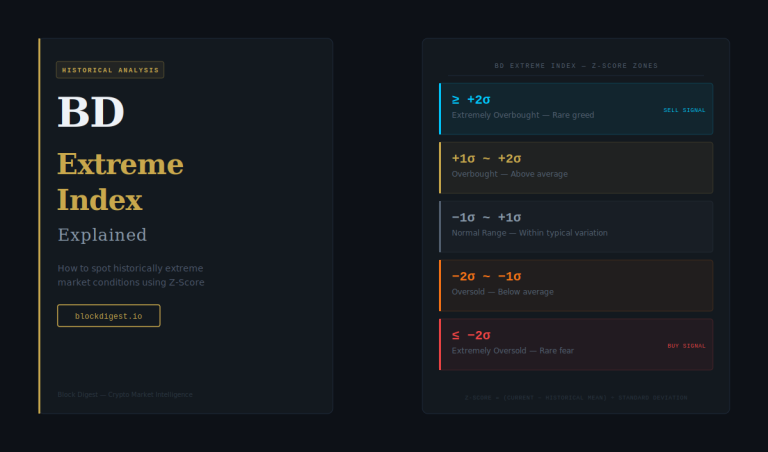
The most powerful way to use funding rate is as a contrarian signal. Extreme readings — in either direction — often mark turning points.
The logic is simple: when funding rate is extremely high, nearly everyone who wants to be long is already long. There’s limited new buying pressure left to push price higher. Any selling triggers a cascade of liquidations that amplifies the move down. The same logic applies in reverse for extreme negative funding.
This doesn’t mean you short every time funding spikes — trends can persist longer than expected. But extreme funding is a clear signal to be cautious about adding to positions in the direction of the trend, and to tighten risk management.
How I Use Funding Rate
1. Pre-entry check
Before entering any significant long position, I check funding rate. If it’s already highly positive, I’m either waiting for it to cool down or sizing down. I don’t want to be paying elevated funding while entering at a potentially overextended level.
2. Combine with on-chain indicators
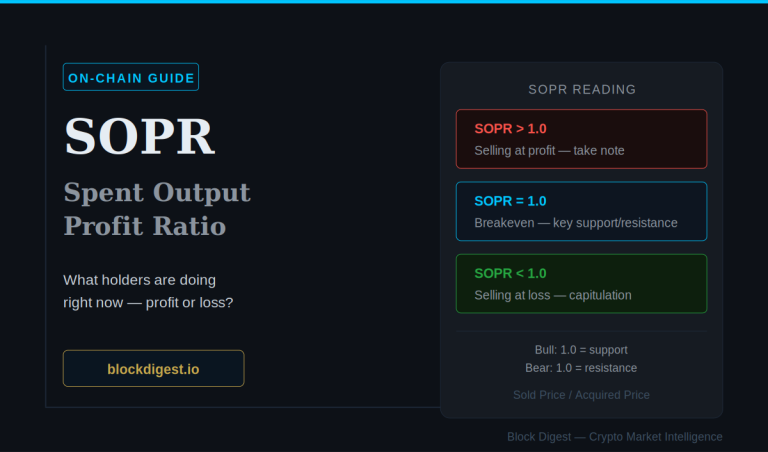
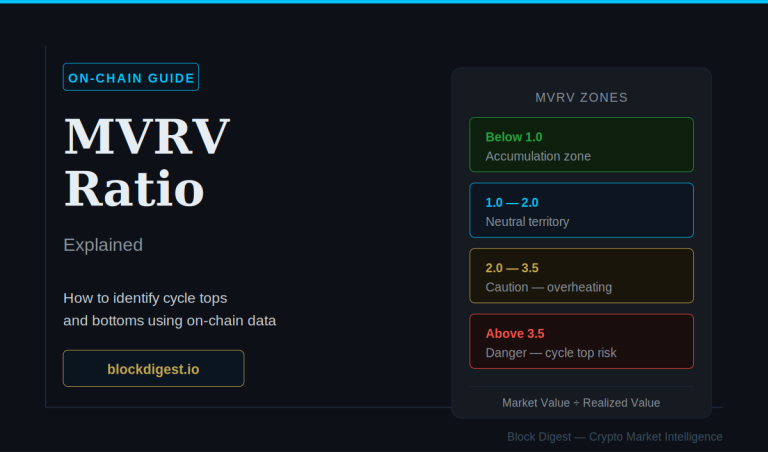
Funding rate tells you about derivatives sentiment. MVRV and SOPR tell you about spot market and on-chain behavior. When all three are flashing caution simultaneously — high positive funding, MVRV above 3.0, SOPR spiking — that’s a much stronger signal to reduce exposure than any single indicator alone.
3. Watch for funding resets
After a period of extreme positive funding, a correction typically brings funding back toward zero or negative. These resets — where overleveraged longs get flushed out — often create cleaner entry opportunities than trying to buy during the frenzy.
4. Don’t use it in isolation
Funding rate is a derivatives market indicator. It reflects what leveraged traders are doing, not what long-term holders are doing. In a strong bull trend, positive funding can stay elevated for weeks without a major correction. Always combine it with broader market context.
Funding Rate and Trading Fees
One practical aspect of funding rate that’s worth understanding: if you’re holding perpetual futures positions, funding payments are a real cost (or occasionally a source of income) that affects your overall P&L.
During periods of high positive funding, being long in perpetuals means you’re paying funding every 8 hours on top of the standard trading fees. Over days or weeks during a high-funding environment, this can meaningfully eat into profits — or amplify losses if the trade goes against you.
Understanding the full cost structure of futures trading — including funding rates, maker/taker fees, and liquidation mechanics — is essential before trading with leverage. If you’re not already familiar with how futures fees work across different exchanges, that’s worth researching before putting capital at risk.
Where to Find Funding Rate Data
- CryptoQuant (cryptoquant.com) — Aggregated funding rate across major exchanges. One of the best free sources.
- Coinglass (coinglass.com) — Excellent funding rate heatmap showing rates across multiple exchanges and assets simultaneously.
- Bitcoin Magazine Pro (bitcoinmagazinepro.com) — Clean funding rate charts with historical data.
Key Takeaways
- Funding rate keeps perpetual futures prices anchored to spot by transferring payments between longs and shorts
- Positive funding = longs paying shorts (market leaning bullish); negative funding = shorts paying longs (market leaning bearish)
- Extreme readings in either direction are contrarian signals — the market is overextended
- Best used alongside MVRV, SOPR, and price structure for fuller context
- Funding payments are a real cost — factor them into your P&L when holding perpetual positions
What to Read Next
Funding rate gives you a read on derivatives sentiment. But to understand the bigger picture of where capital is flowing in crypto markets, you need to understand BTC Dominance — and what it signals about altcoin cycles.
→ BTC Dominance Explained: What It Means for Altcoins
Funding rate is also one of the six components that powers BD Pulse — Block Digest’s proprietary market sentiment score. When funding rate is extreme alongside other indicators, BD Pulse captures that convergence as a stronger contrarian signal. Check the live BD Pulse score to see where the market stands right now.
Disclaimer: This content is for informational purposes only and does not constitute financial advice. Cryptocurrency markets are highly volatile and unpredictable. All trading decisions should be made based on your own research and risk tolerance. Block Digest is not responsible for any financial losses incurred as a result of acting on this content.