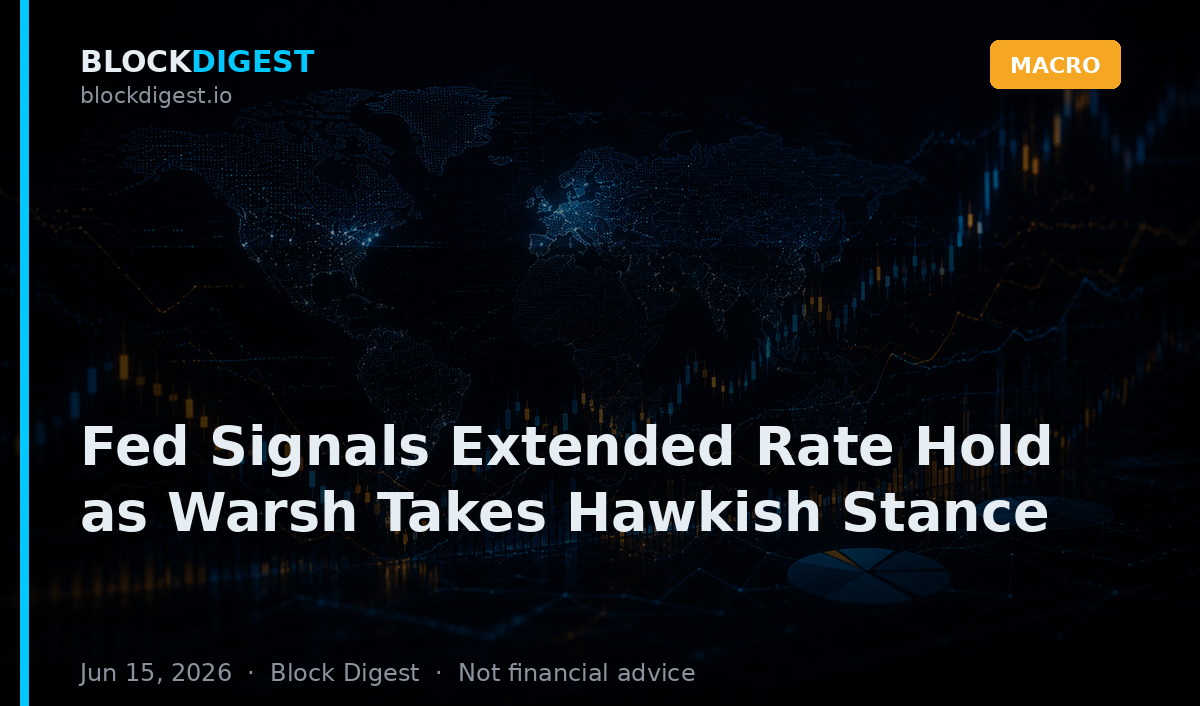
The Federal Reserve held its benchmark federal funds rate steady at 3.50%-3.75% on June 17, 2026, but the real story lies in the hawkish messaging that accompanied the decision—and the immediate crypto selloff that followed. In Kevin Warsh’s first FOMC meeting as the newly confirmed Fed chair, policymakers signaled that rate cuts are no longer coming soon, with inflation described as “somewhat elevated” and policy expected to remain restrictive well into the second half of the year.
The Hold and the Hawk
The 10-2 vote to maintain rates reflected stronger consensus around the Fed’s restrictive stance than many observers had anticipated. The dissent margin—with only two officials breaking ranks—stands in stark contrast to earlier volatility; May’s 8-4 split had marked the first significant dissent since 1992. The shift toward unanimity underscores the central bank’s resolve on inflation control heading into Warsh’s tenure.
What surprised markets was not the rate hold itself, which had been fully priced in, but rather the tone and forward guidance. The post-meeting statement emphasized that inflation remains undefeated and that the Fed will not pivot toward easing until price stability is “firmly on track.” The median Fed projection now calls for only one 25 basis point cut for the remainder of 2026—a dramatic downward revision from earlier expectations of multiple rate reductions before year-end. This represents a fundamental reset in monetary policy expectations and signals that Warsh intends to maintain the restrictive regime he inherited from Jerome Powell.
Inflation Pressures Persist
The economic backdrop justifies the Fed’s hawkish posture. Core Consumer Price Index inflation stood at 3.8% year-over-year in April 2026, with core CPI at 2.8%—both well above the Fed’s 2% target. The Producer Price Index surged to 6.0% year-over-year in April, marking the highest level since December 2022. This acceleration was driven largely by a 17.9% jump in energy prices, tied to geopolitical tensions in the Middle East that continue to pressure global commodity markets.
The Fed’s preferred inflation gauge, core Personal Consumption Expenditures, stood at 3.10% in January 2026, up from 3.0% in December 2025. Consumer prices rose 0.6% month-over-month in April alone, suggesting that disinflation momentum has stalled. This persistent elevation in price pressures has convinced policymakers that the inflation fight remains incomplete and that premature easing could reignite demand-side pressures.
First-quarter 2026 GDP growth of 2.0% annually, supported by private investment and exports, provided some reassurance that the economy could withstand continued monetary restriction. However, the combination of above-target inflation and moderate growth has left Warsh and his colleagues with few easy options.
Warsh’s First Test
Kevin Warsh was confirmed by the U.S. Senate on May 13, 2026, in a 54-45 vote—the most divisive Federal Reserve confirmation in history. He was sworn in as the 17th chair of the Federal Reserve on May 22, just weeks before chairing this FOMC meeting. In comments leading up to the decision, Warsh signaled his commitment to what he termed a “regime change” on inflation discipline, positioning himself as willing to maintain tight policy longer than markets might prefer.
To ensure continuity during the leadership transition, former Fed Chair Jerome Powell has agreed to remain on the Federal Reserve’s board, providing institutional continuity and access to Powell’s inflation-fighting experience. This arrangement may have contributed to the unified messaging around the hawkish hold.
The Crypto Reckoning
The crypto market’s reaction was swift and severe. Bitcoin, Ethereum, and XRP all moved sharply lower following the announcement, as traders digested the reality that the Fed will not provide monetary relief in 2026. The shift in rate-cut expectations directly impacts crypto asset valuations, which tend to perform best when monetary conditions are loosening and liquidity is abundant.
Futures markets have now flipped their baseline assumption. Rather than pricing in rate cuts by year-end, fed funds futures now assign meaningful probability to a rate hike as the more likely move, reflecting the Fed’s inflation concerns and the energy shock driving producer prices higher. This represents a complete reversal from market expectations just weeks ago, when some observers were confidently predicting three to four cuts in 2026.
The timing and tone of the Fed’s messaging—delivered by a new chair promising inflation discipline amid genuine price pressures—has darkened the outlook for risk assets. Liquidity expectations have tightened, and risk appetite has faded considerably. Reuters polled 102 economists and found that 72 believe the Fed will keep rates unchanged through the end of 2026, reinforcing the market’s new defensive posture.
What This Means for the Market
The Fed’s pivot toward extended restriction has reshaped the investment landscape. With rate cuts pushed substantially further out and inflation expectations remaining sticky, financial conditions will remain tight heading into the second half of 2026. For crypto markets, this translates to headwinds from reduced liquidity and lower leverage availability, even as on-chain fundamentals and long-term adoption narratives remain intact.
The key inflection point will come only when inflation data begins a sustained decline toward the 2% target—a threshold that appears months away at minimum. Until then, expect Warsh’s Fed to maintain its hawkish stance, keeping downward pressure on speculative assets while rewarding cash and short-duration fixed income positions.
—
Disclaimer: This content is for informational purposes only and does not constitute financial advice. Cryptocurrency markets are highly volatile and unpredictable. All trading decisions should be made based on your own research and risk tolerance. Block Digest is not responsible for any financial losses incurred as a result of acting on this content.
Stay Ahead of the Market
Follow BlockDigest for crypto market intelligence, research and real-time updates.