Crypto Roundup: Institutional Retreat Clashes With Enterprise Adoption Push
# Crypto Roundup: Institutional Retreat Clashes With Enterprise Adoption Push
Macro Headwinds Weigh on Bitcoin’s Momentum
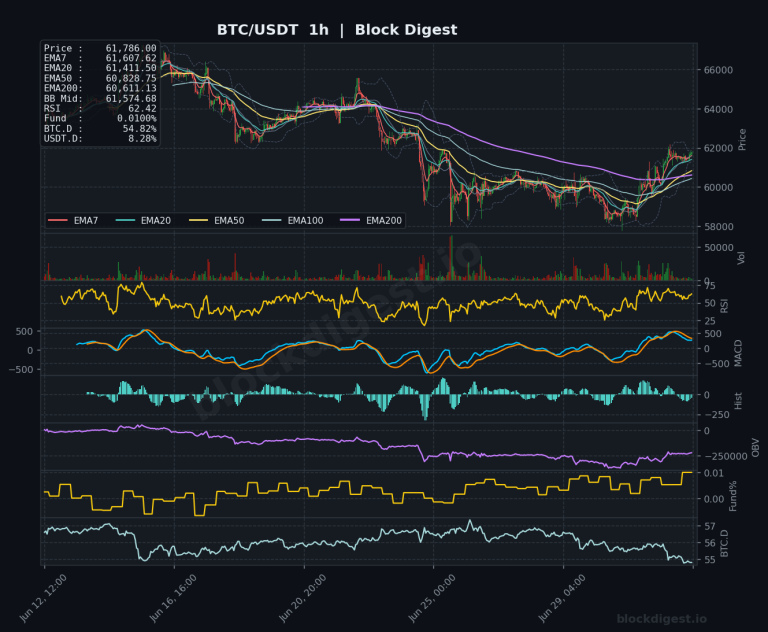
Bitcoin’s price action in early June reflects a market caught between competing forces, with the flagship cryptocurrency hovering near $61,000 amid a challenging backdrop of macroeconomic uncertainty. Recent inflation data meeting expectations has reinforced the Federal Reserve’s commitment to keeping rates elevated for an extended period, undermining hopes for near-term monetary easing that might fuel risk appetite. The combination of persistent inflation concerns, geopolitical tensions, and significant outflows from spot Bitcoin exchange-traded funds has created what many observers describe as the worst stretch for digital assets so far this year. Institutional selling pressure has intensified, with some analysts warning that Bitcoin could test substantially lower price levels if current momentum doesn’t stabilize, though sentiment remains divided on whether markets have truly found a bottom.
DeFi’s Reality Check and the Demand Problem
The cryptocurrency sector witnessed a sobering reminder about the gap between innovation aspirations and market reality when Botanix, a Bitcoin-focused decentralized finance project, announced its shutdown after four years of operation. The Spiderchain developer’s candid post-mortem reflected a broader truth: demand for Bitcoin-native DeFi solutions remains insufficient to support sustainable business models in the current environment. This failure underscores persistent challenges facing decentralized finance builders who must not only create technically sophisticated products but also convince investors and institutions that these platforms warrant adoption over traditional alternatives. Industry observers have begun questioning whether DeFi protocols need to operate with greater accountability and transparency—more akin to regulated financial institutions—to gain the institutional capital necessary for long-term viability.
Enterprise Blockchain and Payment Infrastructure Gaining Traction
While consumer-facing DeFi struggles, enterprise blockchain applications are accelerating across multiple sectors. Mastercard’s introduction of Agent Pay for Machines represents a significant shift toward supporting autonomous AI agents conducting high-volume, low-value transactions using stablecoins and other digital assets. Similarly, Trad.Fi’s plans to tokenize up to $650 million in equipment-finance credit signals growing institutional interest in bringing traditionally off-chain financial instruments onto blockchain networks. The World Series of Poker’s integration of Solana payments for tournament buy-ins demonstrates that major sporting and entertainment organizations are increasingly comfortable offering cryptocurrency payment options to participants. These developments suggest that enterprise adoption is following a different trajectory than consumer-focused DeFi, prioritizing efficiency, regulatory clarity, and institutional relationships over decentralization ideologies.
Regulatory Framework Emerging for Prediction Markets
The Commodity Futures Trading Commission unveiled its long-awaited rule proposal for prediction markets, establishing a framework to determine which contracts serve the public interest and therefore warrant regulatory approval. This development could unlock significant growth potential for a sector that has expanded rapidly but operated in regulatory gray areas. The CFTC’s measured approach—setting clear criteria rather than outright prohibitions—suggests federal authorities recognize the economic value of prediction markets while seeking to manage associated risks. Enhanced regulatory clarity could attract institutional participation and capital to markets that have historically relied on retail enthusiasm, potentially transforming the sector’s scale and legitimacy.
Blockchain Infrastructure Evolution and New Layer Solutions
Multiple projects are pushing blockchain infrastructure toward greater scalability and functionality. Pyth Network’s launch of 24/7 proprietary indices for U.S. equities, oil, and metals—supported by major exchanges including Coinbase and dYdX—extends price discovery capabilities beyond traditional market hours, addressing a key friction point for global trading. Ethereum’s evolution toward zero-knowledge proof infrastructure represents an architectural transformation that Ethereum co-founder Joe Lubin believes could occur within three to five years, fundamentally reshaping how the network handles computational demands. Curve’s expansion of Llamalend v2 on Optimism, supported by a substantial token grant, continues the trend of enhancing layer-two scalability solutions. Additionally, Ripple’s new toolkit for agentic payments on the XRP Ledger reflects growing interest in enabling autonomous agents to execute transactions with minimal human intervention, a capability increasingly valuable as AI systems become more prevalent in financial applications.
Digital Asset Integration Deepens Across Industries
Cryptocurrency’s practical integration into mainstream commerce and finance continues expanding despite macroeconomic headwinds. The onchain gambling sector remained remarkably resilient, reaching $51 billion in 2025 and maintaining robust activity even during broader market downturns, demonstrating sustained demand for stablecoin-based applications. Robinhood’s appointment as an underwriter for major initial public offerings signals growing confidence in retail brokers that have built crypto-native products and constituencies. Securitize’s planned NYSE listing—supported by analyst confidence and substantial valuation targets—indicates that blockchain-focused infrastructure companies are achieving traditional capital market validation. These developments collectively suggest that regardless of near-term price volatility or institutional sentiment shifts, the underlying infrastructure connecting digital assets to real-world commerce continues maturing and expanding.
What to Watch
Investors should monitor whether Bitcoin stabilizes above current support levels or continues deteriorating toward lower targets, as institutional ETF flows and macroeconomic data will likely drive near-term direction. Simultaneously, watch for regulatory outcomes from the CFTC’s prediction market proposal and any developments affecting the UK’s crypto-restrictive banking environment, as regulatory clarity and market access issues will increasingly influence adoption curves. Enterprise adoption metrics across AI payment infrastructure, tokenized credit, and blockchain gaming will provide valuable indicators of where real-world blockchain utility is actually concentrating, independent of asset price movements.
Sources: CoinDesk, CoinTelegraph, The Block
Disclaimer: This content is for informational purposes only and does not constitute financial advice. Always conduct your own research before making investment decisions.