The crypto landscape faces a complex afternoon as institutional infrastructure expands alongside emerging regulatory and competitive headwinds. Today’s roundup examines Circle’s latest financial disclosures, a major shift in decentralized social media governance, and new institutional tools for real-world asset trading.
Circle Reveals Cost Structure Amid Scaling Efforts
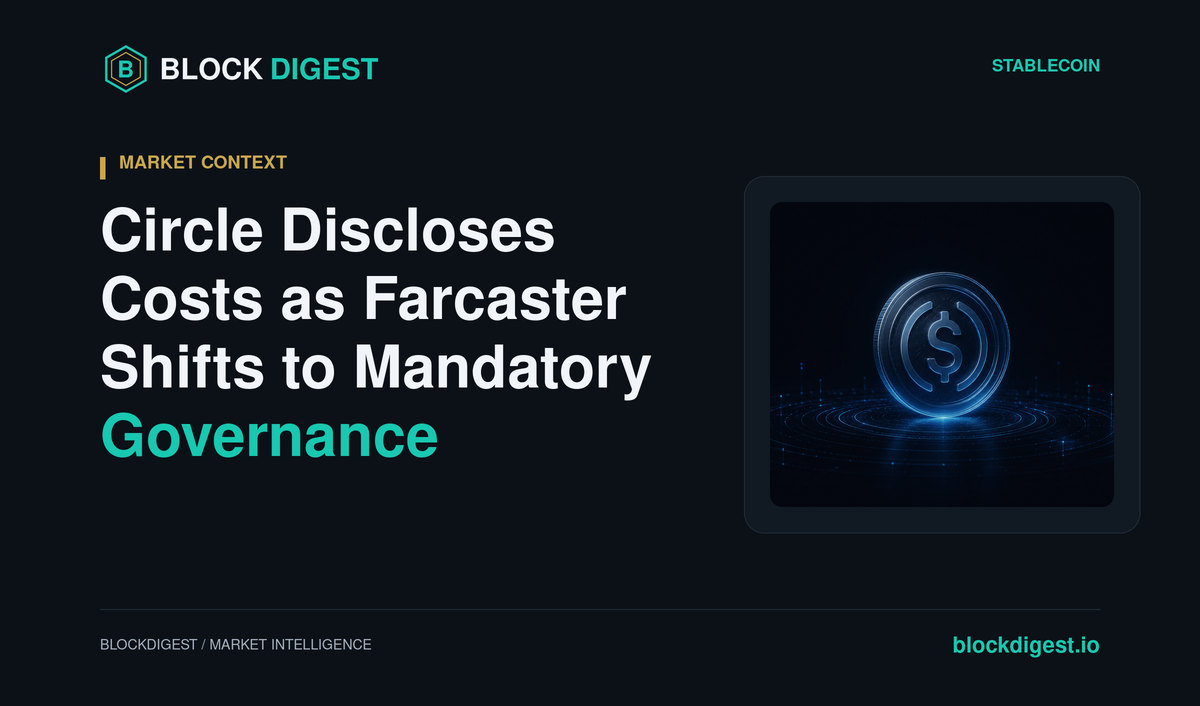
Circle has pulled back the curtain on its operational finances for the first half of 2026, providing a rare glimpse into the economics of the USDC ecosystem. The stablecoin issuer reported total revenue of $1.4 billion for the period. Of that amount, $819 million was directed toward transaction costs and payouts to various ecosystem partners, while $473 million was reinvested into the firm to support its ongoing global expansion. These figures highlight the heavy capital requirements involved in maintaining liquidity and partner incentives as the company attempts to solidify its position in the competitive stablecoin market.
The data arrives as market participants navigate a cautious environment. According to our internal BD Pulse, the market sentiment currently registers at 38.3/100, reflecting a bearish tone as traders weigh these operational costs against broader macroeconomic pressures. Transparency regarding this revenue split offers a clearer picture of the margins involved in running a top-tier stablecoin operation, underscoring the significant overhead required to maintain the infrastructure that supports current USDC transaction volumes.
Network School Takes Control of Farcaster
Balaji Srinivasan’s Network School has officially acquired the decentralized social protocol Farcaster from its previous operator, Neynar. The acquisition marks a significant pivot for the platform, which will now require users to sign a social smart contract to maintain full access to its features. Those who choose not to agree to these terms will be relegated to a read-only mode, effectively limiting their ability to interact or post on the network.
This move forces a choice between platform compliance and user autonomy, signaling a shift toward formal, on-chain governance for social interactions. The transition is expected to reshape the user experience as the community digests the implications of a mandatory smart contract for social participation. By integrating the protocol directly into the Network School ecosystem, the new management aims to enforce a specific standard of engagement that differentiates the platform from its more permissive predecessors.
Ripple Prime Debuts RWA Perpetual Swaps
Ripple Prime is broadening its institutional product suite by integrating real-world asset perpetual swaps that reference futures listed on the Hyperliquid exchange. This expansion allows institutional clients to gain exposure to a diverse array of assets, including energy, metals, currencies, and ETFs. The offering is designed to facilitate 24/7 trading and settlement, providing a bridge between traditional asset classes and decentralized derivatives markets.
The move comes at a time when market participants are closely monitoring volatility and liquidity. The BD Extreme Index currently sits at -0.74σ, suggesting that current market conditions are deviating from the historical norm. By leveraging Hyperliquid’s infrastructure, Ripple Prime intends to offer institutional-grade tools that can withstand these fluctuations while maintaining high-speed settlement. This integration caters to firms that require continuous access to global markets, though the focus remains on whether institutional demand for these synthetic exposures will hold steady amid current bearish sentiment.
Starknet Probes Quantum-Resistant Security
Starknet has initiated a seven-day governance vote to determine the future of its security architecture in the face of evolving cryptographic threats. STRK token holders are now deciding whether to authorize research into the development of an independent Layer 1 blockchain specifically engineered to be quantum-resistant. The proposal stems from mounting industry concerns that current cryptographic standards may eventually become vulnerable to the processing power of advanced quantum computers.
The vote reflects a proactive approach to long-term network survival, as the community weighs the costs and technical requirements of building a new security foundation from the ground up. If approved, the research initiative would mark a significant shift in the network’s development roadmap, prioritizing future-proof security over immediate feature expansion. The outcome of this vote will likely set a precedent for how major Layer 2 ecosystems approach the existential risk posed by quantum computing.
BIS Study Links Bank Rates to Stablecoin Growth
A new working paper from the Bank for International Settlements suggests that the growth trajectory of stablecoins is closely tied to the interest rates offered by traditional banking institutions. Researchers identified a clear correlation between the two, finding that a 1 basis point increase in U.S. bank deposit rates leads to a measurable slowdown in stablecoin adoption over a ten-week period. The paper posits that when legacy financial institutions offer competitive yields, they act as a natural check on the expansion of stablecoin ecosystems.
The findings suggest that the appeal of stablecoins is not solely driven by crypto-native utility but is also highly sensitive to the opportunity cost of holding non-interest-bearing digital assets. As traditional banks adjust their deposit rates, the resulting pressure on stablecoin demand highlights the competitive friction between the two financial systems. This research provides a quantitative basis for the observation that stablecoin growth is not immune to the broader monetary policy environment.
What to Watch Next
The intersection of high operational costs for stablecoin issuers and the dampening effect of traditional bank yields suggests a tightening environment for liquidity providers. Keep an eye on how the market reacts to the Farcaster transition, as the success of its new smart-contract governance could influence how other decentralized protocols handle user compliance in the coming weeks.
Sources: The Block, The Block, The Block, The Block, CoinDesk
Disclaimer: This content is for informational purposes only and does not constitute financial advice. Cryptocurrency markets are highly volatile and unpredictable. All trading decisions should be made based on your own research and risk tolerance. Block Digest is not responsible for any financial losses incurred as a result of acting on this content.
Stay Ahead of the Market
Follow BlockDigest for crypto market intelligence, research and real-time updates.