Bitcoin faces a mid-week correction as broader tech sector headwinds weigh on risk assets, while institutional players and infrastructure providers push forward with significant technical upgrades. Today’s digest covers the retreat from recent highs, the launch of new tokenized banking products, and major shifts in blockchain finality and security standards.
Bitcoin Retreats as AI Hype Cools
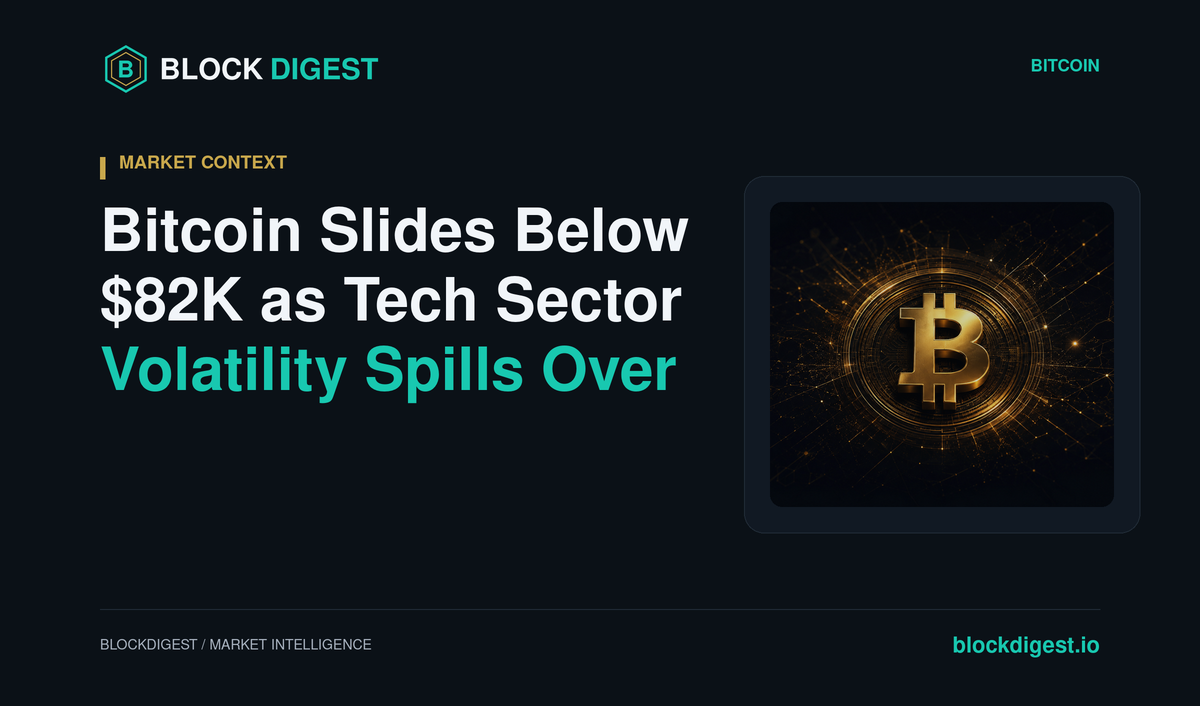
Bitcoin slipped below the $82,000 threshold today, retreating nearly 3% to trade around $81,600 after failing to clear resistance near $85,000. This pullback follows a cooling in risk appetite, driven largely by disappointing earnings reports from the tech sector that have spilled over into digital assets. Decentralized finance tokens have felt the brunt of this volatility, with the sector index sliding 6% during the midday session. Traders are watching the $82,500 level to see if the asset can find a floor as investor enthusiasm for AI-linked projects wanes. Despite the price action, the BD Pulse remains in bullish territory at 57.7/100, and the BD Extreme Index reading of +0.70σ indicates that while the market is deviating from its annual norm, sentiment remains resilient against immediate selling pressure.
SoFi Bridges Banking and Crypto with Tokenized Deposits
Financial services giant SoFi is tightening the integration between traditional banking and digital assets with the launch of SOFIE. This tokenized deposit product provides a bridge for crypto users by offering a 4.4% annual percentage yield alongside the security of FDIC insurance. Customers can move liquidity between their traditional holdings and SoFiUSD, effectively embedding crypto-native functionality into a regulated banking environment. By combining the yield-generating capabilities of decentralized finance with traditional safety nets, SoFi is positioning itself to capture users who are wary of pure-play crypto platforms but interested in the utility of tokenized assets. This move signals a trend among established fintech firms to formalize their digital asset offerings as regulatory frameworks for tokenized deposits mature.
Solana Slashes Finality with Alpenglow Upgrade
Solana has deployed its Alpenglow upgrade, the most substantial technical overhaul for the network since 2020. The update replaces the legacy TowerBFT consensus mechanism, reducing transaction finality from 12.8 seconds to approximately 150 milliseconds. This shift optimizes the network for high-frequency use cases like payments and deposits, providing a near-instant experience for end users. The upgrade requires no action from existing wallet holders, ensuring a smooth transition for the ecosystem. By lowering latency, Solana is attempting to solidify its competitive advantage in the race to support global-scale financial infrastructure that requires sub-second settlement times.
Dune Expands Real-Time Data for Tokenized Markets
Data analytics firm Dune is scaling its infrastructure to meet the demands of an increasingly complex onchain economy. The company has launched a real-time market feed service that aggregates trading data from more than 200 decentralized venues across 12 different blockchain networks. This service provides developers and traders with the granular, high-speed insights necessary to navigate the surge in tokenized market activity. As the volume of assets moving onchain grows, the need for reliable, transparent data feeds has become a primary bottleneck for institutional participants. Dune’s latest offering aims to resolve this by providing a unified view of market activity, allowing for more precise execution in an environment where speed and data accuracy drive competitive success.
Starknet Eyes Post-Quantum Future
The Starknet community has voted to move forward with research into transitioning the network from its current Layer 2 architecture to an independent, post-quantum Layer 1 blockchain. Supporters of the proposal frame the move as a necessary evolution to protect the network against the long-term threat of quantum computing. By establishing itself as an independent Layer 1, Starknet aims to gain full control over its security parameters and consensus rules, shielding users from potential vulnerabilities inherent in existing cryptographic standards. The governance process is moving quickly, with a draft whitepaper detailing the technical roadmap for this transition expected in November. This decision underscores a broader industry pivot toward future-proofing blockchain infrastructure against emerging technological risks.
What to Watch Next
Market participants will be monitoring whether Bitcoin can reclaim the $82,500 level during the upcoming Asian trading session to stabilize broader sentiment. Keep an eye on how traditional equity markets react to further tech earnings, as these continue to dictate the immediate flow of capital into digital assets.
Sources: CoinDesk, The Block, The Block, The Block, The Block
Disclaimer: This content is for informational purposes only and does not constitute financial advice. Cryptocurrency markets are highly volatile and unpredictable. All trading decisions should be made based on your own research and risk tolerance. Block Digest is not responsible for any financial losses incurred as a result of acting on this content.
Stay Ahead of the Market
Follow BlockDigest for crypto market intelligence, research and real-time updates.