
Bitcoin Security Consortium Launches $15M Quantum Research Initiative
Nine major institutional players—BlackRock, Coinbase, Fidelity Digital Assets, Galaxy, and five others—launched the Bitcoin Security Consortium today, pledging a combined $15 million over three years to fund Bitcoin security research and prepare the network for emerging quantum computing threats. The move marks a watershed moment for institutional recognition of Bitcoin’s long-term infrastructure needs and signals serious capital backing for post-quantum cryptography development at a time when crypto markets face broader headwinds from macroeconomic pressures.
The Bitcoin Security Consortium: What Was Announced
The nine founding members—Anchorage Digital, ARK Invest, BlackRock, Block, Blockstream, Coinbase, Fidelity Digital Assets, Galaxy, and MicroStrategy—jointly announced the initiative on July 23, with formal coordination beginning immediately thereafter. Each member has independently committed capital to the effort rather than pooling funds under a centralized grant structure, allowing individual firms to direct resources toward security priorities aligned with their own strategic interests.
Mike Schmidt, Executive Director of Brink—a nonprofit that funds Bitcoin open-source developers—will oversee day-to-day consortium operations. The structure reflects a deliberate choice to maintain organizational independence while creating institutional coordination around a shared security mandate.
Robert Mitchnick, BlackRock’s Global Head of Digital Assets, characterized the commitment as essential to Bitcoin’s future: “Bitcoin Core developers do incredibly important work, and we’re pleased that our firm and the others in this group will now be making significant additional funding available to support Bitcoin’s long-term security needs.”
The Quantum Computing Question
The consortium’s primary focus centers on post-quantum cryptography—technical safeguards designed to protect Bitcoin from computational threats that quantum computers may eventually pose. While large-scale, cryptographically relevant quantum computers remain years away, institutional players are moving forward with defensive measures today rather than waiting for the threat to mature.
Galaxy independently accelerated this timeline two days earlier by announcing a $5 million developer grant program specifically targeting quantum-resistant Bitcoin solutions. Separately, Coinbase has formed its own quantum computing advisory board, and BlackRock has formally listed quantum computing as a risk factor in its spot Bitcoin ETF filings—a symbolic recognition that the topic has crossed from theoretical concern into institutional risk management frameworks.
The timing suggests growing consensus among major Bitcoin stakeholders that quantum preparation, while not an emergency, merits significant resource allocation now. The $15 million pledge represents meaningful but not transformative capital—roughly $5 million annually across nine institutions—yet the institutional coordination may prove more valuable than the raw funding amount.
Market Backdrop and Macro Headwinds
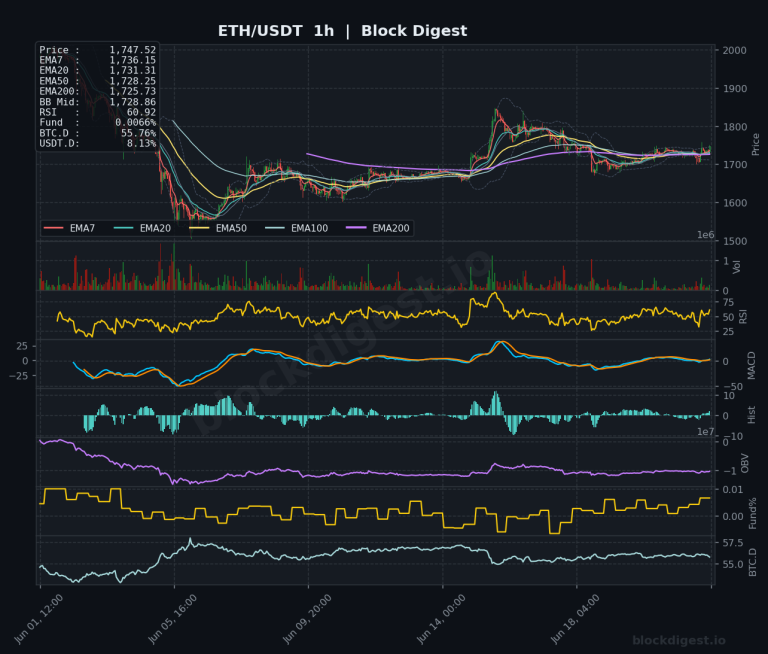
The consortium announcement arrives amid a broader market pullback. Bitcoin declined 1.4% over the past 24 hours to $64,961.68, while Ethereum fell 2.9% to $1,876.92. Overall crypto market capitalization contracted 1.3% to $2.3 trillion, with the Fear and Greed Index sliding to 28—well into the caution zone.
Bitcoin and Ethereum spot ETFs recorded $225 million in combined net outflows on Thursday. However, analysts caution against treating single-day outflows as trend signals; the more telling pattern is Bitcoin’s fifth net outflow this month set against Ethereum’s five-day inflow streak, suggesting institutional rotation rather than broad exit from digital assets.
Higher oil prices and new tariff policy announcements raised inflation expectations, pushing U.S. Treasury yields higher and drawing institutional capital toward less volatile assets. The 145-day duration of the Iran conflict continues to weigh on overall risk appetite across markets, not just crypto.
On-chain pressure compounds the directional weakness. Lookonchain reports that Abraxas Capital moved 2,211 BTC (worth $143.88 million) into Kraken and 30,825 ETH (worth $59.19 million) into Binance within an eight-hour window—positioning typically associated with distribution or hedging activity.
Momentum and On-Chain Positioning
Block Digest’s proprietary BD Pulse Score stands at 50, marking exact neutrality between bullish and bearish momentum. The BD Extreme Index reads at plus-1.03 sigma, suggesting slight overbought conditions on a relative basis. More notably, the Long/Short Account Ratio shows 65.9% of positions are currently long against 34.1% short, yielding a 1.93 long-to-short ratio that indicates a still-elevated net long bias despite recent price weakness.
Bitcoin dominance holds steady at 55.76%, suggesting Ethereum and altcoin weakness is proportional rather than Bitcoin-specific. Funding rates remain modestly positive at 0.0054%, indicating longs continue to pay shorts a small premium—a sign that leverage remains somewhat tilted toward upside positioning despite the down day.
Secondary Developments
Pump.fun generated $1.21 million in daily revenue as of July 23, surpassing Hyperliquid’s $1.03 million in a single-day comparison. Co-founder Sapijiju attributed the revenue advantage to Pump.fun’s hundreds of thousands of active users outside the core Crypto Twitter community, reflecting broadening adoption beyond traditional crypto native audiences.
The PUMP token traded at $0.001912 with a $763.09 million market cap, while HYPE moved 2.39% higher to $58.98 with $14.9 billion in market capitalization. Hyperliquid’s total open interest reached $11.07 billion on July 13, with real-world asset markets contributing $3.69 billion to that figure at all-time highs.
What This Means for the Market
The Bitcoin Security Consortium launch signals institutional confidence in Bitcoin’s long-term viability even as near-term macro conditions remain uncertain. The commitment to quantum-resilience research removes a potential long-term technical vulnerability from the investment thesis without solving it unilaterally, which may appeal to risk-conscious institutional allocators.
Today’s price weakness stems from macro factors rather than crypto-specific sentiment collapse, and the rotation between Bitcoin and Ethereum inflows suggests institutional positioning remains constructive despite tactical pullback—a distinction that could matter if macroeconomic fears ease.
Bitcoin’s ability to hold above $64,000 despite ETF outflows and elevated real Treasury rates may indicate a floor is forming, though the quantum computing commitment alone cannot offset inflation expectations or geopolitical tensions that currently dominate institutional risk appetite.
Disclaimer: This content is for informational purposes only and does not constitute financial advice. Cryptocurrency markets are highly volatile and unpredictable. All trading decisions should be made based on your own research and risk tolerance. Block Digest is not responsible for any financial losses incurred as a result of acting on this content.