
Why Warren Buffett Let Berkshire’s Cash Pile Hit $397 Billion Instead of Chasing the Rally
Sixty Years of the Same Discipline
Warren Buffett bought his first stock at age 11 — three shares of Cities Service preferred, a purchase he later said taught him more about patience than profit. He took control of a struggling textile mill called Berkshire Hathaway in 1965 and spent the next six decades turning it into one of the largest companies in the world. Now 95 and known worldwide as the “Oracle of Omaha,” Buffett stepped down as CEO on January 1, 2026 — but the instinct that built Berkshire hasn’t gone anywhere. It’s on full display in the number that’s been making headlines all year:
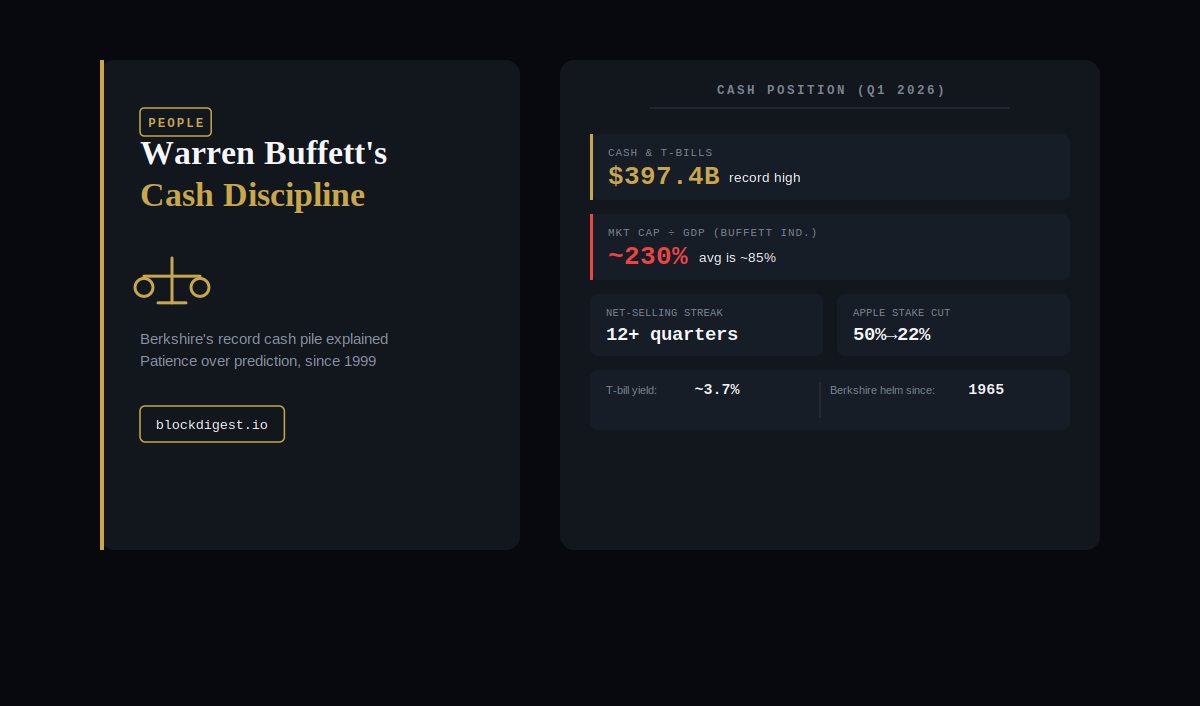
- Cash & Treasuries: $397.4B — record liquid reserves
- Short-Term T-Bills: $339.0B — generating roughly $12B a year in interest
- Buffett Indicator: ~200–230% — versus a historical average near 85%
A Number That Dwarfs the Companies Around It
At the end of the first quarter of 2026, Berkshire’s cash and short-term Treasury bill holdings reached that record $397.4 billion — the highest liquid reserve in the company’s history, and larger than the entire market capitalization of Bank of America, Coca-Cola, or American Express. The pile grew from around $100 billion in 2023 to $373 billion by the end of 2025, and then to today’s record as the broader market pushed further into stretched territory.
What Berkshire Has Been Selling
The cash came from selling, not from doing nothing. Berkshire trimmed its Apple position from roughly half of its equity portfolio down to about 22%, and cut its Bank of America stake by more than half. In the first quarter of 2026 alone, the company sold $24.1 billion in equities against just $16 billion in purchases, extending a net-selling streak that has now run for a dozen consecutive quarters — roughly three years.
Buybacks tell the same story. Berkshire went twenty-one straight months without repurchasing its own shares, sitting out entirely while the stock traded above what management considered fair value. Repurchases only resumed in March 2026, and even then at a token $234 million — a rounding error against a balance sheet this size.
The Metric Behind the Caution
Buffett has pointed to one number as his preferred gauge of market froth for decades: total US stock market capitalization divided by GDP, a ratio now known simply as the Buffett Indicator. He once called it “probably the best single measure of where valuations stand at any given moment.” As of mid-2026, it sits above 200% — by some measures around 230% — a level rarely seen in the ratio’s history.
It’s the same logic behind one of his most quoted lines: “Be fearful when others are greedy, and greedy when others are fearful.” By his own preferred yardstick, most of the market currently qualifies as greedy — which is exactly why Berkshire isn’t chasing it. A modest 5–6% pullback isn’t the kind of opportunity a $397 billion war chest exists for. It’s built for genuine dislocation, not routine volatility.
Crypto markets run on the same contrarian logic, just measured differently. Block Digest’s own BD Pulse reads current conditions as overheated or oversold the way the Buffett Indicator does for equities, and the BD Extreme Index answers the same follow-up question Buffett has spent sixty years asking: not just whether conditions look stretched, but how historically rare that stretch actually is.
History’s Two Previous Warnings
This isn’t the first time Berkshire’s cash has swollen to a record right before markets turned tumultuous.
- 1999: Cash climbed just months ahead of the dot-com crash, which eventually took the Nasdaq down 78% over two years.
- 2007: The pile grew again alongside accelerated selling — and when the 2008 financial crisis hit, Buffett deployed roughly $80 billion into distressed opportunities including Goldman Sachs and General Electric, on terms only available to a buyer with dry powder and no need to sell into panic.
The pattern isn’t proof a third repeat is coming. But it shows what the cash is actually for: not a market prediction, but the option to act decisively when everyone else is forced to sell.
A New CEO, the Same Playbook
Greg Abel’s first quarterly report as CEO showed no departure from the approach Buffett built over sixty years — the net-selling streak continued, and the cash pile grew further still. Attendance at the annual shareholder meeting in Omaha was noticeably thinner without Buffett running the show in person, but the discipline he spent six decades instilling didn’t change hands along with the title.
Key Takeaways
- Product of selective selling: Berkshire’s $397.4 billion cash position is the result of years of disciplined selling — Apple, Bank of America — and a two-year buyback freeze, not a single dramatic bet.
- Stretched valuations: The Buffett Indicator, his own preferred gauge, sits at historically extreme levels around 200–230% against an ~85% average.
- Historical precedent: Two prior instances of record Berkshire cash preceded major market downturns, in 1999 and 2007.
- Institutionalized discipline: Under new CEO Greg Abel, the sixty-year value-investing playbook remains fully intact.
Related Guides
- BD Pulse Explained — Block Digest’s own contrarian sentiment score, built on the same “fade the extreme” logic as the Buffett Indicator
- BD Extreme Index Explained — how historically rare a given reading actually is, the crypto-market answer to Buffett’s own valuation question
- MVRV Ratio — Bitcoin’s version of comparing current price to an underlying cost basis, conceptually close to market cap vs. GDP
- RSI Explained — the overbought/oversold framework behind “be fearful when others are greedy,” applied to short-term price action
Disclaimer: This content is for informational purposes only and does not constitute financial advice. Cryptocurrency markets are highly volatile and unpredictable. All trading decisions should be made based on your own research and risk tolerance. Block Digest is not responsible for any financial losses incurred as a result of acting on this content.