
CLARITY Act Stalls With August 10 Senate Deadline Looming
The CLARITY Act sits on a knife’s edge with just 13 days until the Senate’s August 10 recess deadline, and legislative silence is breeding market uncertainty across digital assets. While House passage was secured and the Senate Banking Committee voted to advance the bill 15-9 in July, no full Senate floor vote has been scheduled, leaving the most comprehensive crypto regulatory framework in U.S. history suspended in procedural limbo as lawmakers prepare for summer break.
The Legislative Stalemate
The Digital Asset Market Clarity Act, H.R. 3633, has cleared every procedural hurdle except the one that matters most: a full Senate floor vote. As of July 24, the bill sits on the Senate Legislative Calendar under General Orders as Calendar No. 423, technically eligible for consideration but without any announced floor time. Senate Republicans released updated legislative text on July 22 that merged competing Banking and Agriculture Committee approaches while adding ethics language negotiated with the White House, a development meant to unblock Democratic concerns about conflicts of interest among government officials with ties to the crypto industry.
Senator Cynthia Lummis, the Wyoming Republican leading the push, signaled urgency in a Tuesday post on X: “We are closer to a functioning digital asset market structure than we have ever been. Now is not the time to flinch.” Yet that message alone underscores the fragility of the moment. The bill requires 60 votes to pass the Senate, a threshold that demands bipartisan support at a moment when Democrats remain hesitant about the latest ethics provisions. Three Democratic senators—Kirsten Gillibrand of New York, Adrienne Alsobrooks of Maryland, and Ruben Gallego of Arizona—are considered the bellwethers for whether their party will publicly respond to the July 22 language revisions.
The critical variable now is whether Majority Leader John Thune files cloture before August 10. No cloture filing means no summer vote, effectively pushing any Senate passage into September or later, after the legislative calendar resets and political calculations shift closer to the November election cycle.
What the CLARITY Act Does
For those unfamiliar, the CLARITY Act would codify regulatory jurisdiction over digital assets by creating a clear delineation between the SEC, which would oversee tokens with investment characteristics (securities), and the CFTC, which would govern commodities and derivatives. This statutory framework would replace the current patchwork of regulatory guidance and enforcement actions, most notably the March 17, 2026 joint SEC-CFTC interpretation that classified 16 major assets including Ethereum, Solana, Cardano, Chainlink, and others, while Bitcoin remains an established commodity under CFTC authority.
The bill also addresses stablecoin issuance, AML compliance requirements, and CFT procedures—issues that have created operational uncertainty for U.S. spot and derivatives trading venues. Without CLARITY becoming law, the March 2026 guidance remains agency guidance rather than statute, leaving it vulnerable to future administration changes or judicial challenge.
Market Response and On-Chain Signals
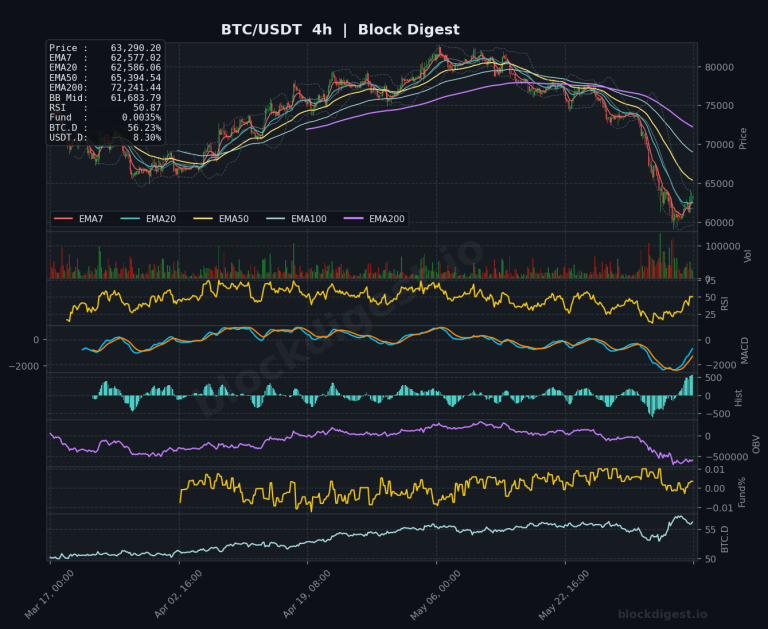
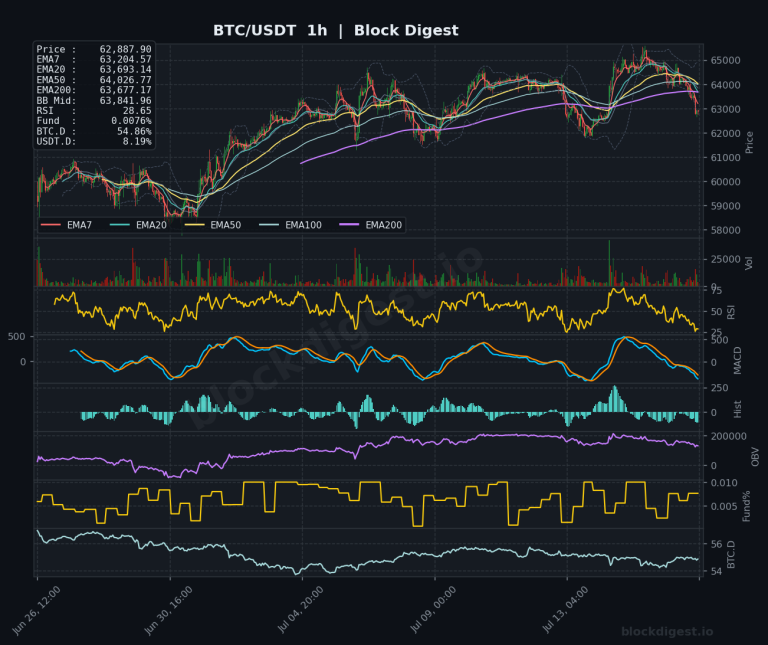
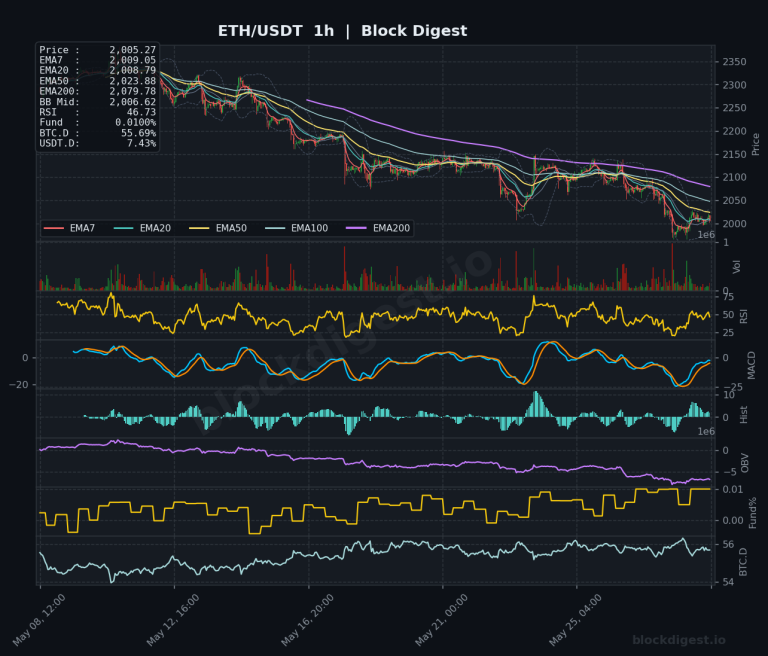
Uncertainty over the bill’s fate, combined with rising expectations for Federal Reserve rate hikes, has triggered a collective downturn across cryptocurrencies. Bitcoin fell to around $63,000 today, down from recent highs, while Ethereum traded near $1,865. The global cryptocurrency market capitalization contracted to $2.26 trillion, a drop of 1.6% in the past 24 hours, with trading volume reaching $65.7 billion.
On-chain sentiment has deteriorated in tandem. Block Digest’s proprietary BD Pulse Score stands at 39 out of 100, signaling a bearish regime, while the RSI at 46.57 indicates neither overbought nor oversold conditions but rather downward momentum. The OBV (On-Balance Volume) trend of negative one reinforces weakness, suggesting that selling volume is outpacing buying pressure. Notably, the long-to-short account ratio remains elevated at 1.88, with longs comprising 65.2% of positions, indicating that despite price declines, retail and leveraged traders are still net long—a configuration that can amplify drawdowns if liquidations accelerate.
Bitcoin dominance held steady at 55.21%, while ETH dominance reached 9.98%. U.S. spot Bitcoin ETF flows turned negative on July 27, with 3,824 BTC in net outflows worth approximately $246.7 million, led by BlackRock’s IBIT shedding 3,307 BTC. This capital flight from institutional vehicles coincided with the regulatory uncertainty narrative and broader macro headwinds.
The August 10 Deadline
If the CLARITY Act fails to pass before August 10, it does not die—but its momentum enters a critical phase. The Senate returns after Labor Day, but by then, the legislative calendar fills with appropriations bills, potential government funding debates, and the approach to November’s election. A September vote becomes materially less likely if Thune does not schedule floor time in the next two weeks, and passage after November could mean waiting until a new Congress in 2027.
Markets have already priced in this risk. Polymarket’s implied probability for CLARITY Act passage in 2026 has “slipped in recent sessions,” according to tracking, as Democratic resistance to the ethics language shows no immediate signs of softening. The broader institutional crypto sector, which had priced in regulatory clarity as a tail risk improvement, is now factoring in extended uncertainty.
What This Means for the Market
The CLARITY Act’s fate will likely determine the trajectory of institutional adoption and volatility in the second half of 2026. Passage before August 10 would signal that U.S. regulatory certainty is materializing and could reverse current outflows into spot ETFs and derivatives venues. A missed deadline, by contrast, prolongs the era of regulatory whiplash, keeping the asset class caught between agency enforcement and legislative gridlock. For traders and institutions, the next 13 days will determine whether digital assets enter autumn with legislative tailwinds or renewed uncertainty headwinds.
Disclaimer: This content is for informational purposes only and does not constitute financial advice. Cryptocurrency markets are highly volatile and unpredictable. All trading decisions should be made based on your own research and risk tolerance. Block Digest is not responsible for any financial losses incurred as a result of acting on this content.