
Bitcoin Retreats on Oil Spike and Inflation Fears Ahead of Fed Meeting
Bitcoin pulled back sharply overnight as surging oil prices and renewed inflation concerns sparked a broad retreat from risk assets, with the flagship cryptocurrency surrendering Tuesday’s gains to settle near $65,877 by late Wednesday. The pullback reflects a classic risk-off reversal that has left market participants divided between residual bullish momentum and mounting macro headwinds ahead of the Federal Reserve’s July 28-29 meeting.
The Overnight Reversal
Bitcoin opened Wednesday, July 22 at $66,508.87, up 2% from Tuesday’s opening, before sliding to $65,556.99 by mid-morning trading. Ethereum followed a similar arc, opening at $1,928.62 before dropping to $1,918.35. The moves erased the prior day’s strength, when Bitcoin had climbed from $65,214.10 to $66,398.15 and Ethereum had risen from $1,903.35 to $1,935.99. By late afternoon ET, Bitcoin settled at $65,876.96 with a 0.7% daily loss, while Ethereum eked out a marginal 0.2% gain to $1,926.83.
The magnitude of the intraday reversal underscores heightened sensitivity to macro signals in crypto markets. Traders who went long at Tuesday’s peak found themselves underwater within hours, signaling that conviction behind the prior day’s rally had weakened substantially.
Oil Spikes, Inflation Fears Return
The primary catalyst for Wednesday’s selloff was West Texas Intermediate crude oil surging past $85 per barrel for the first time since June, igniting dormant inflation concerns that had been temporarily shelved. The move forced a tactical reassessment across risk assets, with investors pivoting away from growth-sensitive trades and toward havens including gold, silver, and traditional safe-haven currencies.
This dynamic proved double-edged for Bitcoin. On one hand, the cryptocurrency’s historical role as an inflation hedge should theoretically support prices during periods of rising commodity costs. On the other hand, surging oil prices typically precede broader Fed tightening cycles, which compress valuations for assets priced on future cash flows and reduce appetite for speculative positions. The yen weakness that accompanied these moves added another layer of friction, as carry-trade unwinds historically correlate with volatility across all markets.
For traders, the calculus became clear: macro risk-off dynamics trump near-term crypto fundamentals when oil moves sharply higher. The question now centers on whether the oil spike represents a temporary disruption or the start of a sustained inflationary impulse heading into the Fed’s next policy decision.
On-Chain Signals Show Caution Amid Strength
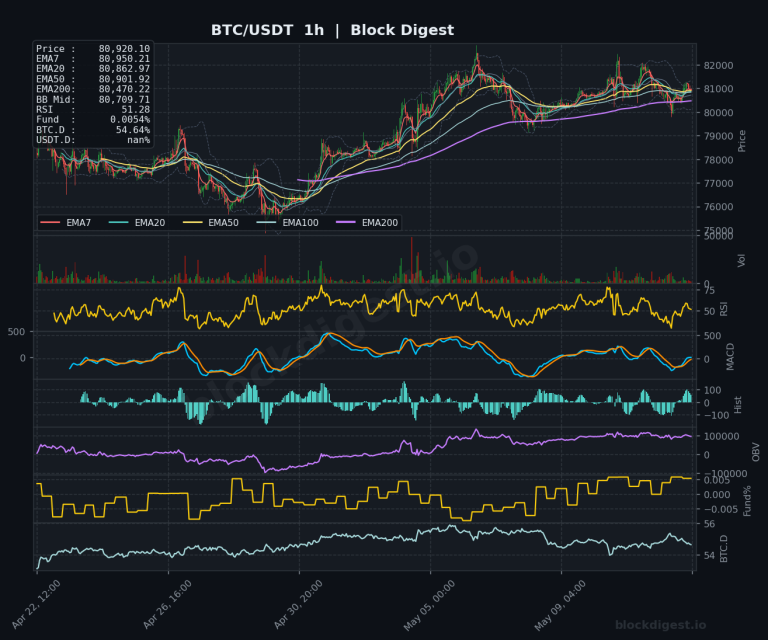
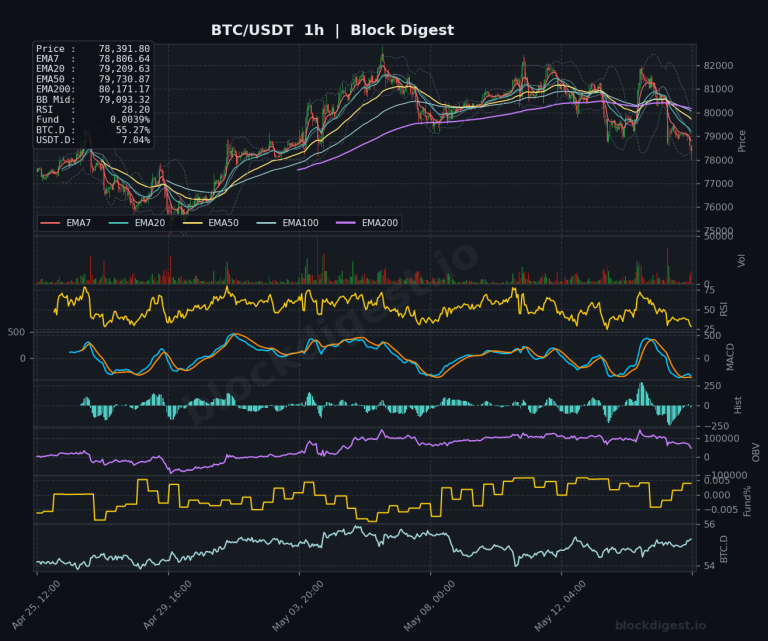
Block Digest’s proprietary BD Pulse indicator sits at 61 out of 100, registering as bullish but with important caveats embedded in the broader on-chain landscape. The BD Extreme Index stands at plus 1.28 standard deviations, suggesting overbought conditions that align with the technical pullback observed Wednesday. Bitcoin’s Relative Strength Index registered 57.53, neither deeply overbought nor oversold, indicating room for either directional move.
What stands out is the positioning mismatch. The long-to-short account ratio sits at 1.28, with 56.1% of accounts holding long positions against 43.9% short. This suggests moderate bullish lean, yet the On-Balance Volume trend has turned negative at minus 1, hinting that volume has been declining on up moves and accumulating on down moves. Such divergences historically precede reversals, particularly when macro catalysts are present.
Bitcoin dominance, meanwhile, holds steady at 55.56%, indicating that capital rotation into altcoins remains muted even as Bitcoin itself retreats. Funding rates in perpetual futures remain extremely tight at plus 0.0049%, suggesting that leveraged longs are not aggressively loading positions—a sign that even bullish traders are hedging against tail risk.
ETF Inflows Provide Counterweight
A bright spot emerged in US spot Bitcoin ETF activity, which snapped a painful 10-day losing streak by pulling in $221.7 million on Tuesday, marking the largest single day of inflows in two months. This came after June proved to be the worst month on record for Bitcoin ETF flows, a dark period that preceded the recent bounce.
The rebound in institutional demand signals that some longer-term capital still sees dips as buying opportunities. Notably, this represents the second consecutive week of positive net inflows, the first such back-to-back performance since May. For a market battered by three months of institutional selling, renewed institutional interest carries outsized psychological weight.
However, Wednesday’s price action suggests that Wednesday’s inflows may have dried up or reversed, pending official settlement data. Timing matters greatly in markets where negative momentum can rapidly overwhelm positive flows.
Analyst Sentiment Splits
Standard Chartered renewed its year-end 2026 Bitcoin price target of $100,000, offering a floor for bullish positioning. However, analyst commentary from July 20 painted a more sobering picture: prominent on-chain analyst Darkforst highlighted that early Bitcoin buyers who accumulated between $75,000 and $126,000 are now deep underwater, signaling weak hands may be in pain and unlikely to drive demand.
The divergence between institutional price targets and retail pain points reflects a market in transition, where different cohorts of market participants hold fundamentally different conviction levels.
What This Means for the Market
The immediate outlook hinges on Federal Reserve communications and crude oil price action over the coming week. The July 28-29 FOMC meeting looms as the key catalyst, and markets will parse every comment from Fed officials for signals about the path of interest rates. If inflation concerns continue to build—whether from oil, wage data, or other channels—the Fed may extend its current hawkish hold-pattern, keeping downward pressure on speculative assets.
Bitcoin’s ability to hold above $65,500 will be critical, as a break below this level could trigger stop-losses and cascade into broader selling, particularly among overleveraged longs. Conversely, a stabilization near current levels coupled with moderating oil prices could reignite the institutional momentum captured by this week’s ETF inflows.
The crypto market remains hostage to macro forces beyond its direct control, and that dependency will persist until either Fed policy pivots clearly dovish or inflation expectations collapse.
—
Disclaimer: This content is for informational purposes only and does not constitute financial advice. Cryptocurrency markets are highly volatile and unpredictable. All trading decisions should be made based on your own research and risk tolerance. Block Digest is not responsible for any financial losses incurred as a result of acting on this content.