
Bitcoin, Ethereum Fall as Geopolitical Shock Offsets CPI Relief
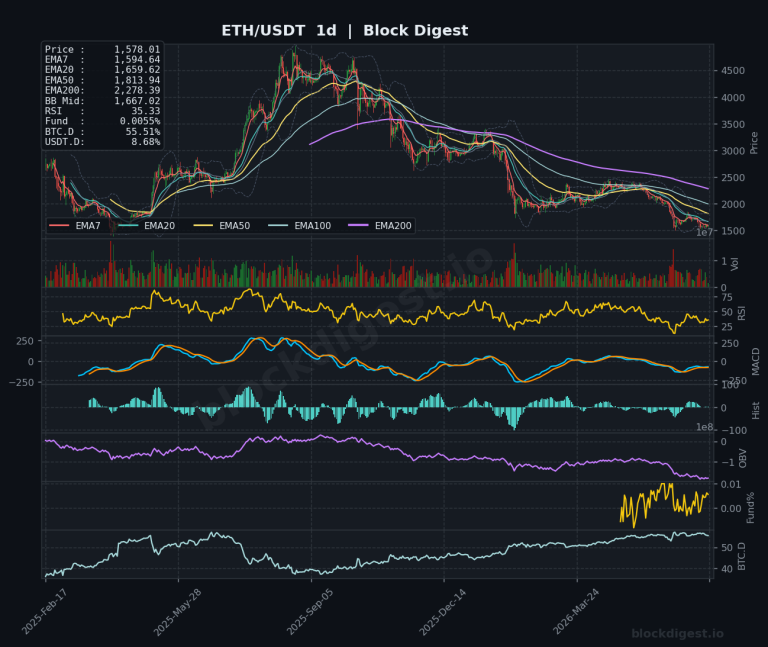
Bitcoin and Ethereum retreated on July 14 as geopolitical tensions and conflicting macro signals created a fragile market environment, with both assets opening sharply lower before recovering modestly through the session. The overnight action underscored mounting pressure on institutional investors, as negative flows from spot Bitcoin ETFs and a 50-day streak of weak Coinbase premium readings signal eroding U.S. demand even as inflation data offered tentative dovish signals.
The Overnight Selloff
Bitcoin opened Tuesday down 2.3% at $62,259.16, while Ethereum fell 1.8% to $1,774.10 following the strongest opening prices in weeks on Monday. The decline came as the Trump administration reinstated pressure on Iran and reimposed the Hormuz blockade, reigniting oil market volatility that undercut the benefit of overnight inflation relief. Bitcoin managed to firm to $62,865.44 by 8:21 a.m. ET, with Ethereum adjusting to $1,785.68, but the recovery proved tentative against a backdrop of deteriorating institutional conviction.
The session reflected a market caught between two competing narratives. The June Consumer Price Index report fell 0.4%, marking a genuine cooling in inflation that had previously supported Federal Reserve rate hike expectations. This should have been unambiguously bullish for risk assets including Bitcoin and Ethereum. Yet the geopolitical shock of renewed U.S. pressure on Iran and the reinstatement of Hormuz blockade measures sent crude oil prices higher, reversing the “peace trade” that had helped crypto recover in early July and introducing renewed macroeconomic uncertainty.
Institutional Demand Signals Flash Red
The most troubling development for crypto bulls lies not in spot price action but in on-chain metrics revealing deteriorating institutional participation. The Coinbase Premium, which measures the price differential between Bitcoin on U.S.-based Coinbase and major offshore exchange Binance, has now turned negative for 50 consecutive days. This extended negative reading typically indicates weak institutional demand from U.S. investors and suggests that domestic money is either absent or actively reducing exposure.
This weakness arrives amid a broader institutional exodus from spot Bitcoin ETFs. Over the May-June period, Bitcoin ETFs have shed approximately $7 billion in outflows, marking the most significant redemption pressure since the products launched. The outflows underscore how thin conviction has become among the large asset managers and institutional allocators who were supposed to provide sustained demand for crypto assets as they matured.
Ethereum, meanwhile, has faced its own institutional headwinds. The second-largest cryptocurrency opened lower on Tuesday and struggled to fully recover, reflecting similar structural softness in demand from the sophisticated end of the market.
Stablecoins and Tokenized Equities Signal Divergent Trends
Offsetting some of the bearish sentiment, the stablecoin market revealed telling stress. Total stablecoin market capitalization fell to $312 billion in June, representing the largest monthly decline since the TerraUSD collapse in 2022. The pullback suggests retail participation may be cooling as confidence wavers, though the magnitude remains within historical bounds for normal market cycles.
More intriguingly, tokenized equity volumes surged 145% to reach a record $3.86 billion, indicating that institutional and retail participants remain active in regulated asset tokenization products even as they reduce exposure to core crypto holdings. This divergence hints that capital is rotating between product categories rather than simply fleeing digital assets entirely.
Macro Uncertainty Defines the Session
The June CPI report’s 0.4% decline should have provided clear tailwinds for Bitcoin and Ethereum, which typically benefit when inflation expectations decline and rate hike timelines extend. However, the simultaneous reignition of geopolitical risk through the Hormuz blockade created crosscurrents that prevented sustained strength.
Oil prices, which had stabilized in early July and supported a crypto recovery, reversed course as tensions escalated. Higher energy costs risk rekindling inflation expectations and creating economic headwinds that contradict the dovish CPI signal. This is precisely the type of conflicting data environment that leaves investors uncertain whether to treat recent weakness as a buying opportunity or a warning sign of deeper troubles.
By session close on July 14, the global cryptocurrency market cap stood at $2.24 trillion, down 0.57% in 24 hours. The modest decline masks the internal volatility and structural stress evident in institutional flows and on-chain metrics.
What This Means for the Market
The overnight action on July 14-15 reflects a market structure increasingly reliant on macro signals while simultaneously suffering from deteriorating institutional conviction. The Coinbase Premium’s 50-day negative streak and ETF outflows totaling $7 billion over two months paint a picture of U.S. institutional investors either sitting on the sidelines or actively unwinding positions. Meanwhile, the inflation relief embedded in the June CPI report remains vulnerable to geopolitical shocks that could reignite energy price spirals and economic uncertainty.
Bitcoin and Ethereum face a critical test in the coming sessions: whether dovish inflation data can sustain momentum despite geopolitical headwinds, or whether rising oil prices and institutional outflows will extend the recent decline into a more significant correction that tests lower support levels.
Disclaimer: This content is for informational purposes only and does not constitute financial advice. Cryptocurrency markets are highly volatile and unpredictable. All trading decisions should be made based on your own research and risk tolerance. Block Digest is not responsible for any financial losses incurred as a result of acting on this content.