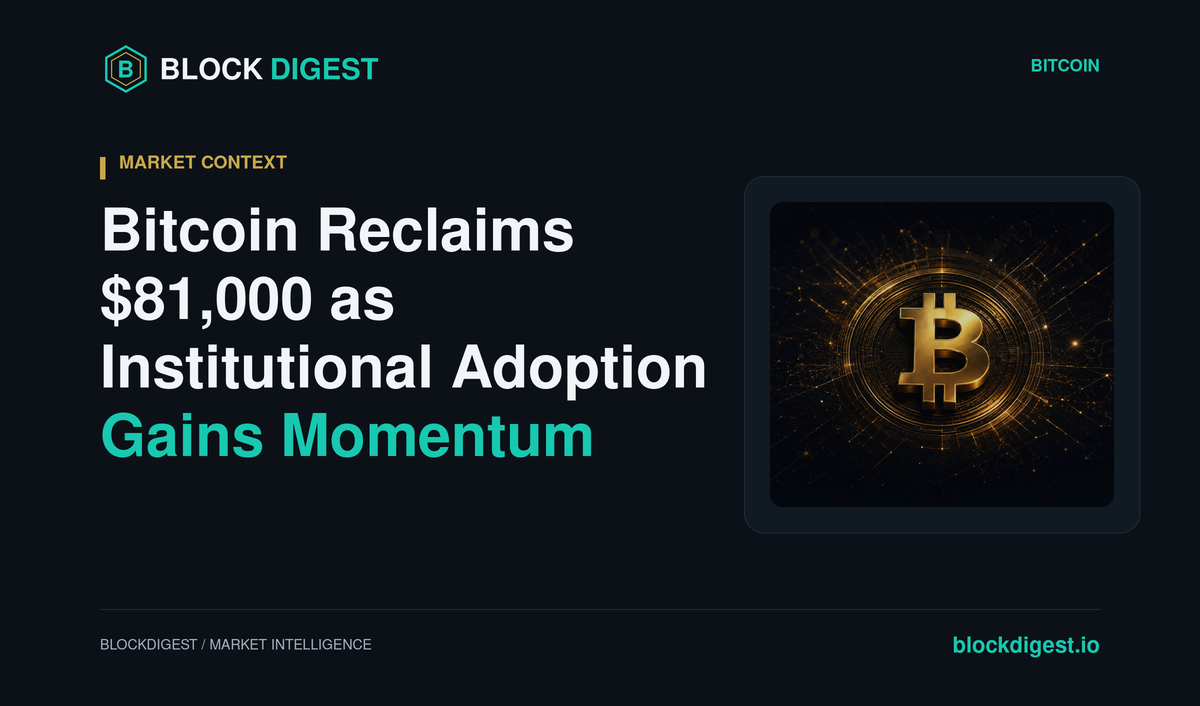
Bitcoin has reclaimed the $81,000 threshold as a rally in Asian semiconductor stocks spills over into digital assets, driving renewed interest across the crypto ecosystem. Institutional adoption continues to accelerate through new regulatory milestones in Brazil and fresh security infrastructure from major tech players.
Bitcoin Reclaims $81,000 Amid Tech Sector Tailwinds
Bitcoin surged back above the $81,000 mark on October 28, trading near $81,400 during midday hours. This rebound mirrors a wave of optimism emanating from Asian chip and semiconductor markets, which has bolstered risk appetite globally. While price action remains positive, Block Digest data shows the BD Pulse reading for the period ending October 28 closed at 42.0/100, signaling a bearish market context. This reading is underscored by the BD Extreme Index, which sits at -0.48σ relative to the prior year. Memecoins are capitalizing on the momentum despite these cautious indicators, with Pepe leading the charge among smaller assets by posting a 9% gain. Traders are now shifting their focus toward the Federal Reserve, positioning their portfolios ahead of the central bank’s interest rate announcement scheduled for Wednesday. The current global long/short account ratio for BTCUSDT perpetuals stands at 1.86, with 65.0% of accounts holding long positions, indicating that retail and professional sentiment remains heavily skewed toward further upside.
Moody’s Validates Ripple’s RLUSD Stablecoin
Ripple has secured a major institutional endorsement as Moody’s Ratings assigned its RLUSD stablecoin an A2 long-term rating and a P-1 short-term rating. The credit agency cited the high quality and total market value of the underlying reserve assets as the primary drivers for the assessment. By achieving these investment-grade ratings, Ripple strengthens its position as it scales its institutional payment infrastructure. This validation provides the transparency and trust often required for large-scale financial institutions to integrate stablecoins into their treasury workflows. The move is expected to facilitate broader adoption of RLUSD, particularly among firms that require rigorous credit verification before committing capital to blockchain-based payment rails.
Google Targets AI-Driven Threats with New MPC System
Google is moving to address the risks of AI-powered cyberattacks by launching a private preview of its new Multi-Party Compute security system. Designed for digital asset custody, the technology aims to mitigate vulnerabilities that arise as hackers deploy sophisticated artificial intelligence to target crypto holdings. Several major financial institutions are testing the infrastructure to protect their digital assets. Within Alphabet, the company is utilizing this MPC framework to secure its own holdings across the Ethereum and Solana networks. As the threat landscape evolves, Google’s entry into the custody security space signals a trend of big tech companies integrating proprietary security stacks with blockchain networks to safeguard institutional-grade capital.
Enterprise Treasury Management Shifts Toward Tokenized Cash
A report from DBS reveals that 90% of large-scale enterprises are actively integrating or planning to use tokenized cash to streamline settlement processes. The shift represents a change in how corporations manage their treasuries, with stablecoins emerging as the preferred instrument for 63% of surveyed firms. Tokenized deposits and money market funds are also seeing traction, with adoption rates of 53% and 52% respectively. These figures highlight a preference for blockchain-based settlement over traditional banking rails, which are often slower and more costly for cross-border transactions. By moving liquidity onto the chain, these enterprises aim to achieve near-instant settlement, reducing the capital drag associated with legacy financial systems.
Itaú Unibanco Formalizes Crypto Brokerage in Brazil
Itaú Unibanco, the largest bank in Brazil, has officially notified the country’s central bank of its crypto trading and custody operations. This filing makes the institution the first major bank to formalize its digital asset brokerage business under the nation’s recently updated regulatory framework. The move arrives just days before the October 30 deadline, by which all crypto-service providers in Brazil must comply with new licensing requirements to continue operations. By formalizing its status, Itaú Unibanco is setting a precedent for traditional financial institutions in Latin America, signaling that the bank intends to integrate crypto services directly into its existing retail and institutional banking offerings. The bank’s proactive compliance underscores the importance of regulatory clarity in attracting major financial players to the digital asset space.
What to Watch Next
The convergence of institutional regulatory compliance in Brazil and the rise of tokenized treasury management suggests a maturing landscape for enterprise-grade digital assets. Keep an eye on Wednesday’s Federal Reserve interest rate announcement, as the market’s current long-heavy positioning could trigger significant volatility if the central bank’s commentary deviates from investor expectations.
Sources: CoinDesk, The Block, CoinDesk, CoinDesk, CoinDesk
Disclaimer: This content is for informational purposes only and does not constitute financial advice. Cryptocurrency markets are highly volatile and unpredictable. All trading decisions should be made based on your own research and risk tolerance. Block Digest is not responsible for any financial losses incurred as a result of acting on this content.
Stay Ahead of the Market
Follow BlockDigest for crypto market intelligence, research and real-time updates.